
MOON Logo
------- PRODUCTS -------
  New Products
  MOON Evolution Series
  MOON Classic Series
  Older Products
----- INFORMATION -----
  Simaudio News
  Press Releases
  Product Awards
  Product Reviews
  Education
  Literature
  Recommended Music
------- COMPANY -------
  Background
  Factory Tour
  Photo Gallery
  Unauthorized Sales
  Career Opportunities
  Contact Us
------- SUPPORT -------
  Where To Buy
  Product Registration
  Owner's Manuals
  F A Q
  Factory Upgrades
  Service
Simaudio Company Background                     Updated: August 30, 2008

Introduction

Simaudio Ltd., a Canadian audio and video equipment manufacturer, has been in business for nearly 30 years, designing and building high quality electronics for home entertainment use.

The focus of Simaudio is to provide ultimate enjoyment to the customer from the use of high-end home entertainment music and surround systems. To that end, Simaudio is committed to building the finest, best sounding, longest lasting and most aesthetically attractive equipment one can own for a given price. To achieve this, Simaudio realizes that conventional wisdom with respect to engineering and general business practices are insufficient in today’s competitive marketplace. Therefore, all products manufactured by Simaudio reflect a forward-thinking engineering process that is considered a generation ahead of the competition. Simaudio considers first-rate customer service as paramount. The ultimate enjoyment of a quality product is shattered by a distasteful experience of poor quality after-sale service.

With all this in mind, Simaudio has a global mission statement:

“To offer the best products, services and education to individuals for enhancement of quality of life while preserving our natural resources and respecting our planet."


History

In 1980 Simaudio began producing affordable yet high quality home audio products for the home and professional industry. The company rapidly gained a local reputation for its products offering a level of quality that was considered a definite step above the competition. Company philosophy, local manufacturing and a passion for music all played key roles in the early success of Simaudio.

As the company’s market share grew, it’s product range followed. In the 1980’s Simaudio won favor amongst many an audiophile with key models like the famous PW-3000, an affordable integrated amplifier that sold so well that demand often exceeded supply. The entire 3000 series of integrateds, power amplifiers and preamplifiers received exceptionally high praise from virtually every Canadian audio publication. In fact, today we still service such products with the same care and pride as any current model.

The 1990’s saw the introduction of the Celeste series. Our original “Renaissance” circuitry for power amplification was first implemented at this time. These famous oval-faced Celeste products became instantly recognizable for both their elegant appearance and transparent sonics. Stereophile magazine gave the W-4070 power amplifier a benchmark review for its sub-$1500 price, calling it “a remarkable achievement at any price” and awarded it a place in their coveted “Recommended Components” list. This technology was further refined through painstaking research and development; “Advanced Renaissance” circuitry is still used today in our MOON Classic series models.

In 1997 Simaudio launched its reference-grade series of audio products, aptly named the MOON Series. Utilizing many new in-house developed technologies and building on the immensely successful Celeste products, the MOON series considered by many to be the pinnacle of what is achievable when innovation meets technological creativity. Today, the MOON Classic series continues with an expanded range of models and still receives numerous international accolades.

With the rapidly increasing popularity of high-performance Home-Theater systems, Simaudio introduced the MOON Titan multi-channel amplifier in early 2001, the first model of our MOON A/V Series. Bringing years of award winning amplifier design “know-how” to the table, our design team created one of the very first high powered multi-channel amplifiers with a thermally interconnected chassis to ensure exceptional sonic performance across all channels at all times. The Titan has earned a universal reputation as the finest amplifier of its kind and can be found in countless reference grade multi-channel systems worldwide.

To celebrate our 25th anniversary in 2004, we recognized the colossal success of the Nova and Eclipse CD Players, P-5 preamplifier, W-5 power amplifier and i-5 integrated, by manufacturing limited runs of 250 special units of each model. This comprised the MOON Limited Edition series. Each model featured circuit enhancements to raise the bar on performance as well as special cosmetics.

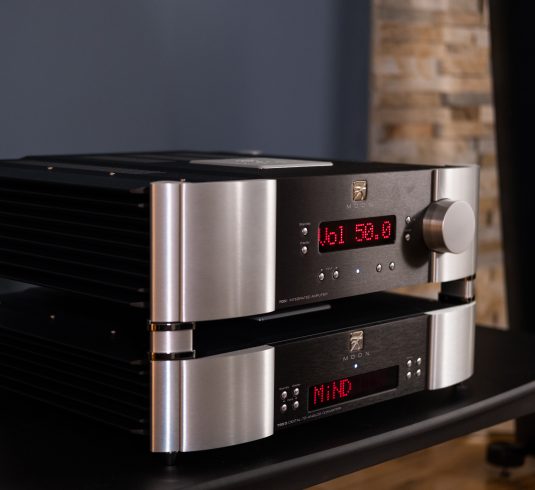
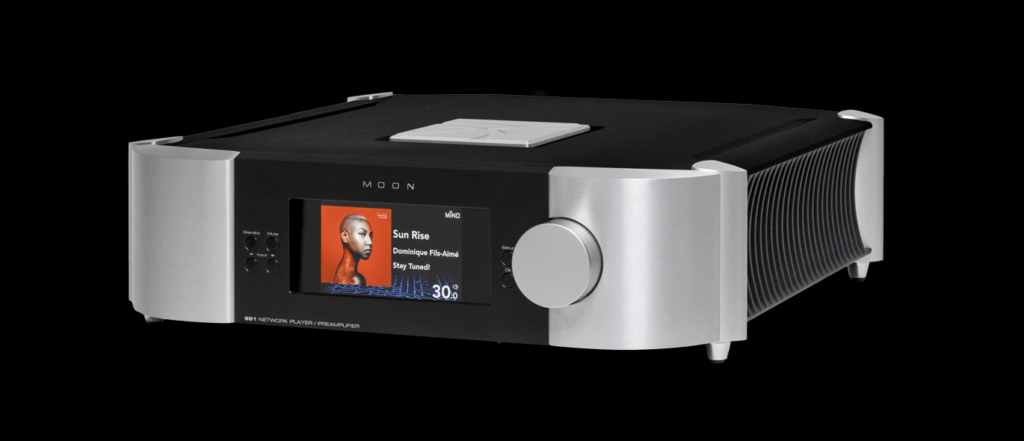
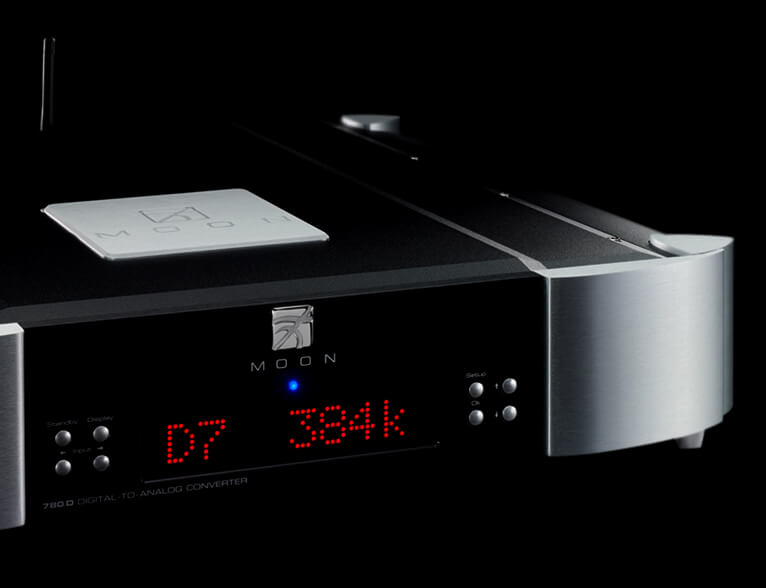
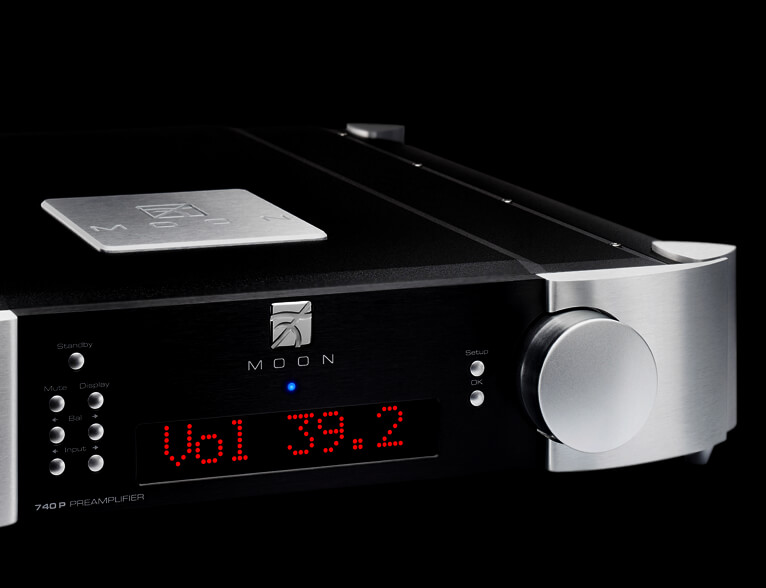
In 2005, we introduced the MOON Evolution series. A product line that embodies life-like sonic performance, luxurious styling, unique flexibility and genuine ease-of-use; A combination unprecedented in the world of high-end audio. The ultimate goal is to provide the customer with a genuine lifestyle enhancement. Common features to Evolution series components include an (i) RS-232 port allowing for both full integration into a custom-install environment and future factory software upgrades, (ii) 12 Volt triggers and (iii) C4 Aesthetics package allows you to customize these component's physical appearance to best suit your needs and/or match your listening room decor.

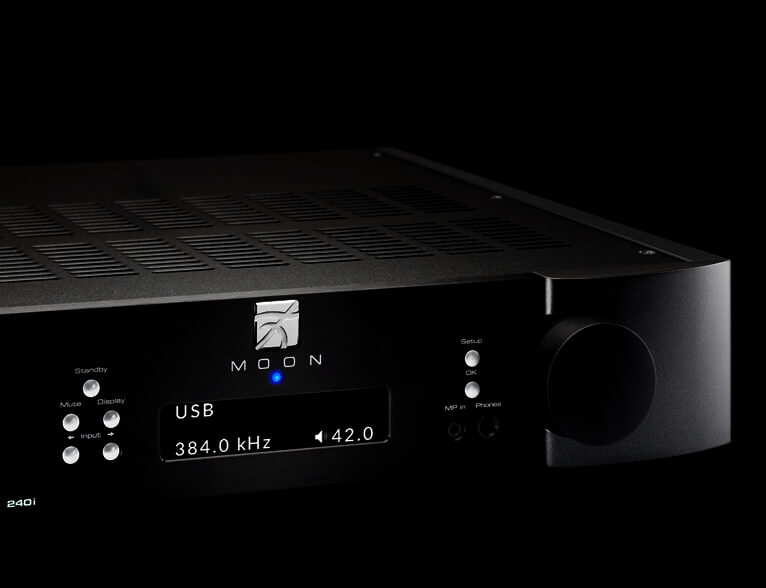
More recently, in 2007, a new series of MOON components became a reality; The “1” series offers an unprecedented level of performance at a cost that was previously unattainable in the world of high-performance audio. This significant milestone is due largely as a result of our many years of successful R&D, allowing us to offer what is commonly referred to as “trickle down technology”.

Finally, in 2008, we've brought the MOON Evolution series to the next level with the introduction of multi-channel components; The CP-8 Preamplifier / Processor, the MC-8 Multi-channel power amplifier and the HDS-8 HDMI switcher. This trio makes up what is, without a doubt, the ultimate home-theater package. The level of performance offered here, simply put, raises the bar to a previously unimagineable level and redefines what is commonly referred to as the State-of-the-Art.


Product Highlights

MOON products are designed for a lifetime of enjoyment. To achieve this, substantial obstacles must be overcome in their creation, design, execution and manufacturing. With this in mind, the following goals must be fulfilled:

 ·  Products shall be user-friendly and a easy to operate
 ·  Products shall combine pleasing aesthetics with user-friendliness
 ·  Products shall employ only top-grade components
 ·  Technical design shall reflect a level of advanced engineering in each product category
 ·  Sonic performance shall be superior to that of all competitor’s similarly-priced products
 ·  Products shall be manufactured with top-level precision and quality control
 ·  Every product shall bench-test equal or better to the original prototype
 ·  Products shall provide many years of trouble-free service to its owner

All of this sounds good in theory and may appear easy to achieve for some. However, the truth is that obstacles always exist and must be overcome to meet these expectations.

One of the most common issues is the constant and timely procurement of high-quality parts. For most manufacturers, components like mains power transformers, chassis parts, faceplates, volume potentiometers and many others must be purchased from industrial suppliers. Parts inevitably end up discontinued, or replaced with “equivalents” and delays are caused for various reasons ranging from financial to ecological, often leading to a product’s life cycle being shortened and its market reputation being negatively affected.

We don’t claim to build our own capacitors or our own connectors. However, we are several steps ahead of the competition in the above dilemma. We manufacture everything in-house that most competitors have to buy. This includes chassis parts and PCB assembly. We have our own metal shop for machining, we develop our own software for both our preamplifier controller sections & CD drives, and we fabricate our own packaging materials. These assets allow us to have much greater control over areas of manufacturing that are easily affected by external factors. The result is more timely delivery, and a better cost advantage, which is passed on to the dealer and ultimately the consumer, making MOON products more marketable by increasing the value/dollar ratio.

At Simaudio, we use numerous in-house developed technologies. They are the result of our highly experienced R&D department where relationships exist with the CNRC (Canadian National Research Council). Some of these technologies are not readily available to the competition, giving MOON products both a technical and sonic edge. They include:

   ·  I2DCf (Independent Inductive DC) voltage regulation
   ·  M-Ray and e-VOL volume control circuits
   ·  SimLink™ software control
   ·  Lynx Zero-Feedback amplifier circuitry
   ·  Extremely short capacitor-free amplification signal paths

Each one of these significant design features enhances the functionality, sonic performance and long-term reliability to previously unattainable levels.

I2DCf voltage regulation circuitry virtually eliminates background noise and sonic colorations, yielding more lifelike dynamics. It works as follows; There is one inductor dedicated to each integrated circuit type component (DAC, Op-Amp, etc.) in the audio circuit’s signal path. The MOON Andromeda CD Player and MOON P-8 preamplifier employ 56 and 40 such stages of filtration respectively.

M-Ray attenuation is Simaudio’s exclusive method of controlling the volume. The only real high-quality alternative to this is a state-of-the-art potentiometer, which is sonically inferior or a shunt-to-ground type circuit, which although it can sound excellent, isn't as precise in terms of the number of selectable volume settings. In a nutshell, with M-Ray, the audio signal passes through a unique combination of precision resistors, the overall parallel or series resistance which is unique and calculated for each volume setting. These surface mount resistors possess very accurate tolerances of 0.1%, are of the thin film variety, and chosen for their incredibly neutral sonic character.

The entire process is microcomputer controlled via a discrete relay network. The signal is never converted to digital, nor is it processed in any way. As well, with this type of circuitry, we can physically place the gain section at the optimal spot on the circuit board, regardless of the actual location of the volume control, thus helping to shorten the overall length of the signal path. Unlike potentiometers whose internal contacts and moving parts eventually oxidize, the M-Ray circuit suffers from absolutely no degradation whatsoever even after many years of use. Finally, two major benefits of this volume control circuit are a previously unattainable signal-to-noise ratio and a plethora of unique volume settings – a staggering 530 unique steps respectively in the case of the extraordinary MOON P-8 preamplfier. The e-VOL attenuation is based on the same design principals as M-Ray, with the most significant differences being the relay network isn’t discrete and a total of 130 unique volume are available in the case of the i-7 Integrated Amplifier and P-7 Preamplifier.

SimLink™ provides communication features between various MOON components that allow you to control various functions of all components from just one. For example, if you switch one component into standby mode, all linked components will also go into standby mode. As well, when you adjust the brightness level of one component's digital display, the linked component's displays will adjust accordingly. In a nutshell, SimLink™ provides for genuine ease-of-use.

Zero-feedback circuitry is not new to many amplifier designers. What is new is the substitute for this circuitry; many manufacturers use a variant called feed-forward; others use other “exotic” circuits. Truthfully, the exotic circuits usually do work, but at an incredible cost to the consumer. Simaudio’s solution is a custom in-house designed and executed circuit called Lynx. It uses no feedback without the usual substitutes either. The result is what we refer to as “real-time” amplification that is lightening quick. It provides incredible control over a loudspeaker’s voice-coil motion and possesses an incredibly high damping factor. There is no other amplifier circuit quite like this.

The innovation of capacitor-free and short signal-paths is not new, but more costly than standard amplifier-design practices. Capacitor-free circuits have the substantial advantage of not acting filters at low frequencies, thereby allowing the bass frequencies of the signal to pass through without frequency limitation, roll-off, speed and phase-shift. Basically, there is less resistance which allows for a greater level of transparency. Adding capacitors, even the best audiophile ones, are a technological step backwards. In addition, by removing the capacitors, the signal paths are simpler and now shorter. By also removing features irrelevant to sound, such as video switching, tone-control circuits, other “sound-improving wonder-circuits”, the traditional potentiometer-volume control, and a few other circuits, the signal’s distance can be brought down to a few inches. This translates to fewer components in the signal path (but what components there are, are of a very high quality), and naturally, less resistance/impedance. The end result is a less altered audio signal.


Differential (Balanced) vs. Single-ended Circuitry

There has been, and continues to be, a lot of discussion in the both the audio industry and in audiophile circles about which circuit topology is better: differential (balanced) or single-ended. We would like to clarify the truth about each one.

Excellent results can be achieved from each, as far as the human ear’s resolving abilities are concerned. However, from an engineering perspective, it has been easily demonstrated, both measurably and sonically, that differential circuits always have an advantage when they are properly executed. The only downside is that a well-implemented balanced circuit is always expensive. To know why, you must understand how a proper balanced circuit works:

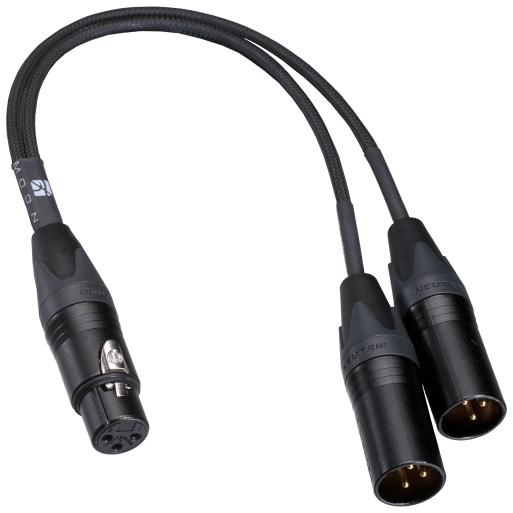
When using an unbalanced interconnect, the audio signal runs through both the center wire and the shield/ground wire. Any noise picked up by this interconnect (ie. nearby magnetic fields such as an AC power cord) will be reproduced by the amplifier and heard through the loudspeakers. Conversely, a balanced interconnect has three separate conductors; one for the ground and two for the actual signal. These two signals are identical except that one is 180 degrees out of phase with the other. For example, when one conductor is carrying a signal of +5 Volts, the other will be carrying a signal of –5 Volts. When these two inverted signals on a balanced line are input into a differential power amplifier such as the MOON W-5, any noise picked up by the interconnect will be eliminated since a differential circuit amplifies only the difference between these two signals: Noise on a balanced interconnect will be equal on both conductors and therefore not be processed.

The sonic results of balanced audio circuitry are undeniable: increased headroom at all frequencies, lower noise floor and greater dynamics. It’s like removing a veil between you and your favorite music. However, as previously mentioned, there is a financial penalty: since the signal’s two phases are processed separately, twice as much circuitry is required. The parts must be of the highest quality for it to make any sense at all - do you put cheap tires on your Ferrari? When a new product is designed to fit into a relatively lower price point, the choice often comes to which circuit design to use.

Our engineering & listening tests have shown with inneffable clarity, that a good single-ended circuit will sonically outperform a cheap balanced circuit. We therefore exercise caution to anyone thinking of purchasing a relatively inexpensive product that claims balanced circuits – it is most likely that the single-ended inputs/outputs of these products will actually outperform their balanced connections. Therefore the conclusion must be that the balanced connectors are there purely for marketing purposes. There are even some manufacturers that install balanced connectors on their products without having any balanced circuitry at all! Sure, the connectors work, but with no advantage over the single-ended RCA connections whatsoever.

We keep it simple and do it right. Balanced circuitry exists in our more expensive gear simply because balanced done right sounds better. And rest assured that when you see a balanced (XLR) connector on the back panel of any MOON product, there is true, fully balanced circuitry inside of a very high quality. And where there is no balanced connector, the single-ended circuitry inside is without peer – rivaling and surpassing most similarly priced competitors’ “balanced” gear.


Several other design features common to our MOON components that are worthwhile to mention here include:

Large power supplies using custom proprietary designed toroidal transformers with very low magnetic, electrical and thermal loss, yielding a much better than average power transfer and lower regulation factor. The end result is improved current speed and better dynamics.

Extremely rigid chassis construction employing thicker & heavier materials than the competition's similarily priced offerings, as well as footers using spiked cones. The whole purpose of these measures is to provide mechanical grounding which helps eliminate external vibrations that deteriorate the musical signal through the introduction of sonic colorations.

Simaudio MOON components, including of our amplifiers, feature low operating temperatures. This results in a significantly longer life for the product and allows for it to be powered up at all times, thus providing for continuous optimal performance.

All of our circuit boards use pure copper tracings. This eliminates sonic colorations and lowers the circuit's capacitance. The result is that the audio signal's purity and inegrity are maintained.

Our preamplifiers circuits, including the ones used in our integrated amplifiers, operate in pure “Class A” mode. This yields better linearity throughout the frequency spectrum, lowers the noise floor and improves musical transparency.


Summary

At this point it should be quite obvious that MOON components offer numerous unique technologies and exceptionally high build quality; the end result being audio and video components that invariably surpass the competition, especially when the "bang for the buck" equation is factored in.

In a nutshell, Simaudio believes in evolution, not revolution. Our products today have a delicately balanced combination of timeless appearance, battleship-build quality and jaw-dropping sonic performance. There is no miracle science to this – Simaudio’s engineering team is not made up of magicians. It is the result of the passion for music & film coupled with very advanced R&D facilities, masterminded by raw engineering brain power that relentlessly pursues musical perfection.


  MOON Logo
Point-and-click here to return to the top of this page